
INTERNATIONAL CONFERENCE - BUCHAREST
AgriVision 2026
As Romanian agriculture enters the knowledge era, the Romanian Farmers' Club brought together experts from ten countries in Bucharest for the first international dialogue between farmers and intellectual capital experts to address the vital importance of food security in an age of geopolitical uncertainty and climate crises.
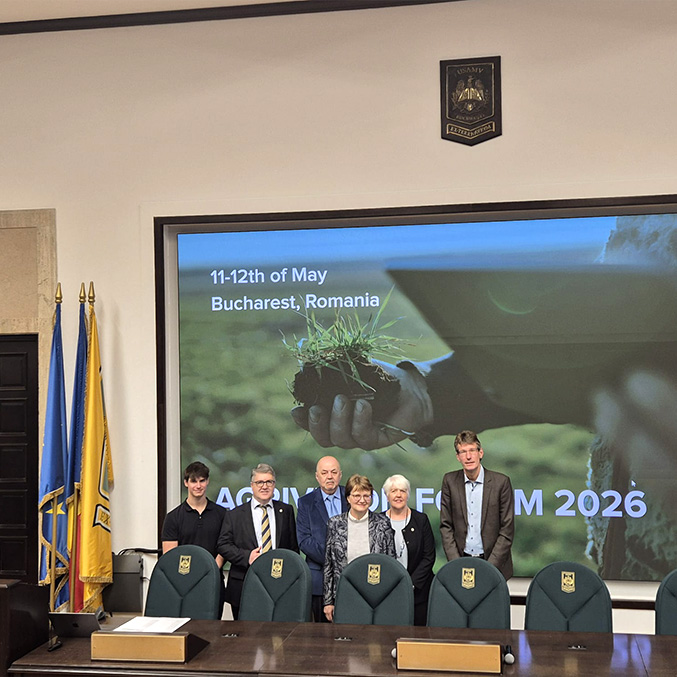
AgriVision Forum 2026 in Bucharest
On 11 and 12 May 2026, the Romanian Farmers’ Club (Clubul Fermierilor Români) organised AgriVision Forum 2026 in Bucharest — the first international conference of the Romanian agricultural sector held in partnership with the New Club of Paris (NCP) and the World Capital Institute (WCI). The event brought together more than 40 experts, farmers, researchers and agricultural policy representatives from ten countries, against the backdrop of the most profound restructuring of European agricultural policy in three decades.
The AgriVision Forum 2026 took place at the intersection of three structural pressures redefining European agriculture
1. The post-2027 Common Agricultural Policy (CAP) budget proposed by the European Commission in July 2025 represents, in real terms, a 20–30% reduction compared to the current cycle. The leading European farmer organisations described the announcement as “Black Wednesday for European agriculture.”
2. The fifth year of the war in Ukraine continues to disrupt grain markets, with direct effects on Romanian farmers — the only country in the region that has not restricted Ukrainian cereal imports.
3. The generational crisis in Romania deepens these vulnerabilities as 52% of European farmers are aged 55 or over, and in Romania 21% of the workforce is employed in agriculture — the highest share in the EU — with 85% of farms below 5 hectares, at subsistence level.
Romania holds 13.5 million hectares of agricultural land and a net cereal exporter position within the European Union. Yet this potential remains underutilised: only one in four farmers uses digital tools, 37% of the sector’s turnover derives from public funds, and Romania receives €5 per capita from European funds for agricultural research, compared to €100–500 in western member states.
“Knowledge has become the most competitive agricultural input. Fertiliser costs are not falling, pesticides are increasingly restricted, and interest rates remain high. The only variable a Romanian farmer can control is efficiency — and that comes from adopting digital tools and from knowledge transfer. AgriVision Forum has built the first real bridge between our farmers and the researchers who are redefining the knowledge economy at the European level,” said Florian Ciolacu, Executive Director of the Romanian Farmers’ Club.
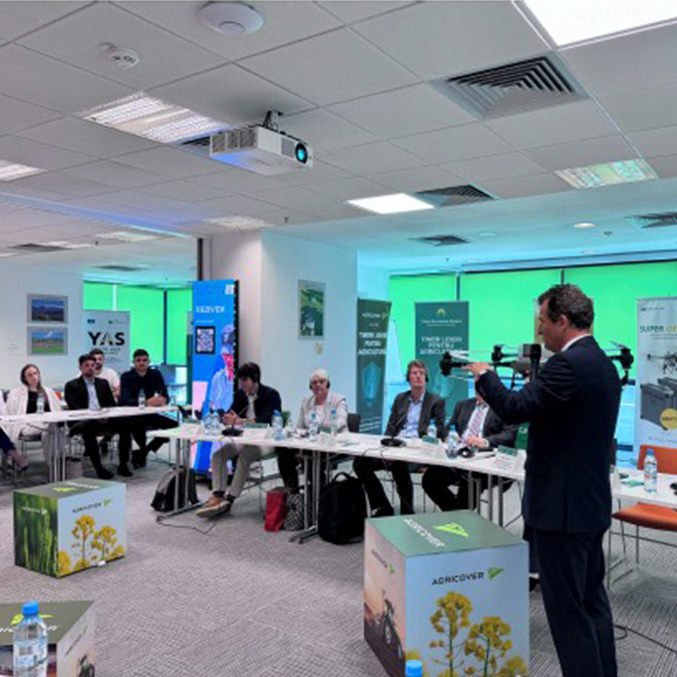
My contribution to the “AgriVision” vision conference organised by the Romanian Farmers’ Club in May 2026
Like WCI President Cathy Garner, I found myself somewhat apprehensive when I agreed to actively participate in the event by giving a presentation at the invitation of the Romanian Farmers’ Club. Neither Cathy nor I had previously dealt specifically with the topic of agriculture in the context of discussions within the WCI, although Cathy has the advantage of coming from a farming family and having gained a genuine understanding of farming during her youth. I would describe my own experience in this regard as rather naive; it was shaped on the one hand by media reports on the European Union’s agricultural policy – after all, the agricultural fund accounts for the largest chunk of its budget – and, on the other hand, by first-hand observations of structural change in land and landscape management, particularly in mountainous terrain, where arable farming and livestock rearing are, at best, only viable with considerable technical effort.
I also fondly recall the anecdote from when, in my role as head of Austria’s largest research organisation, I welcomed the Duke of Liechtenstein – Austria’s largest forest owner – to our biology institute. He, being quite knowledgeable on the subject, wished to learn from us how genetic interventions, particularly in plants, especially trees, growing in alpine regions, could be used to halt soil erosion in these areas by promoting afforestation at high altitudes. For me, this was an early indication of the new specialist skills that will be required in the future for the management of challenging territories. Taking such thoughts further in the context of the current debate on artificial intelligence led to the idea of asking myself what might be devised in the specific case of envisioning *) a future agricultural policy for Romania.
In the presentation reproduced here, I have developed two theses:
1.The programme launched by the Farmers’ Club to introduce Agriculture 4.0 should not be seen as merely adding further current technologies – drones being a prime example – but should instead take the bold leap straight into the next phase, under the heading of Agriculture 5.0, in which, above all, new AI-related professions for and within the agricultural sector should be introduced.
2. An agricultural policy for a country such as Romania, given its highly differentiated and polarised agricultural structure between large-scale farms and millions of subsistence farms, requires a differentiated agricultural policy, which I propose should be structured into four distinct policy areas as follows and developed in a differentiated manner.
-
-
Large-scale, AI-founded precision farming in fertile plains provoking high productivity agriculture.
-
Traditional mixed farming maintained for biodiversity and tourism, thus caring for ecological-cultural landscapes.
-
Abandoned marginal areas returning to natural ecosystems, leading to rewildered or semi-wild land
-
Combining food production, energy generation, tourism management, carbon storage, and ecosystems services ending in multifunctional rual landscapes
-
For us as members of the WCI – who usually engage in highly intellectual and abstract discourse - being involved in this conference has had the wonderful effect of providing us with a range of new experiences and ‘down-to-earth’ insights. Let’s see what further discussions this leads to.
*) Looking back on my time as head of the Austrian Research Centers, I organised a think tank, the findings of which I published in a (German-language) book entitled “Visioning of Non-University Research in Austria”. This lineage also includes a second work, which I was explicitly commissioned to compile by the later Romanian Minister of Science, Adrian Curaj, and which bears the title “Designing the Landscape of the Intellectual Capital of a Nation”. This work was commissioned specifically for Romania.